


By Matt Edwards
Two states, one ballot day, and a country quietly writing Dear John letters.
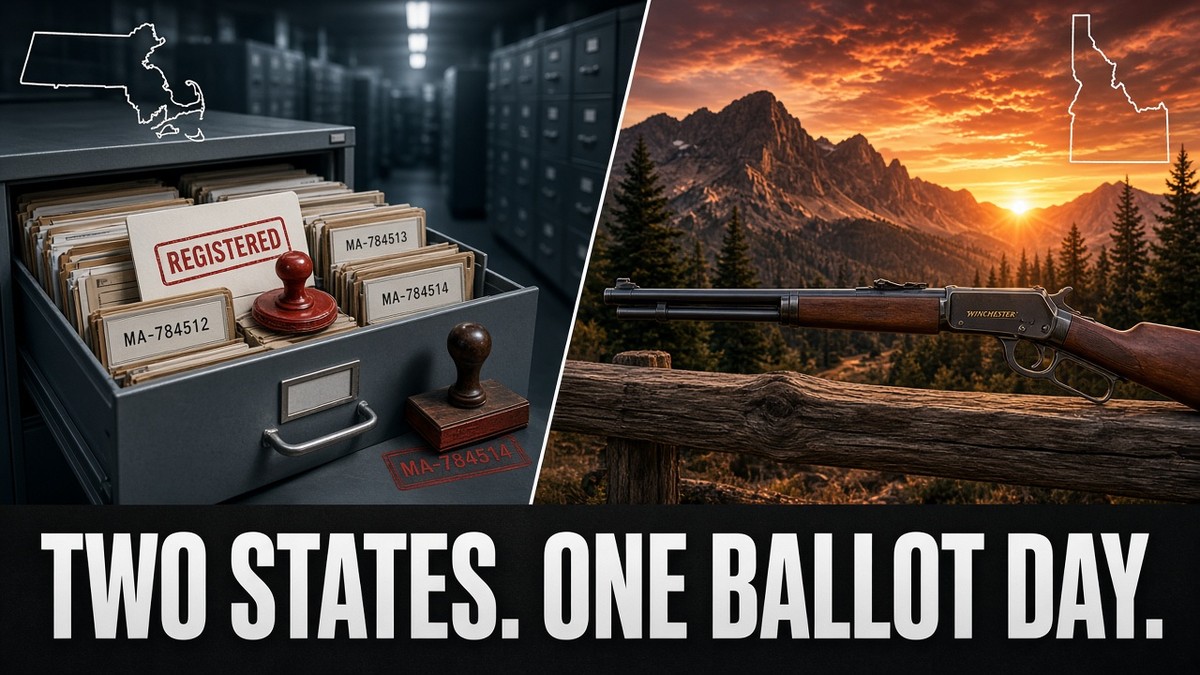
On November 3, voters in Massachusetts and Idaho will both find firearms on their ballots. The direction on where America is heading are found within those two separate questions.
In Massachusetts, Question 9 asks whether to keep Chapter 135 of the Acts of 2024, a law that is apparently 116 pages long. Ch. 135 requires firearms to carry serial numbers and be registered with the state, broadens the ban on so-called assault-style weapons, and adds healthcare providers and school administrators to the list of people who may ask a court to confiscate a citizen’s guns.
Here is what is actually on the line. A yes vote keeps all of it in place: the serial numbers, the state registration system, the broader assault-style weapon rules, a requirement that you be 21 to own a semi automatic rifle or shotgun, and a wider circle of people who may ask a judge to take a citizen’s guns. A no vote repeals the whole law. Massachusetts voters, in other words, are being asked whether they consent to being cataloged. The tragedy is that the answer is in doubt.
In Idaho, the Legislature put a different question to voters: Which of six historic firearms should become the official state gun? The choices include the Winchester Model 1873, the “Gun that Won the West,” and the Winchester Model 1894; the 1873 Colt Single Action Army “Peacemaker”; the M1 Garand of World War II and Korea; the Colt M1911 pistol; and the Remington Model 700.
The vote is advisory, meaning the Legislature would still need to act to make the designation official. House Majority Leader Jason Monks, who sponsored the measure, said he hoped it would encourage more Idahoans to turn out this November. Call it a stunt if you like, but it has merit. Idaho is asking its people to honor the tools that fed families, guarded homesteads, and won wars. Massachusetts is asking its people to treat them like contraband.
Idaho’s bill explains itself in language you rarely hear from a modern legislature. It says the Second Amendment protects the right to keep and bear arms “as a safeguard against tyranny and for personal security.” It recalls Lewis and Clark relying on rifles to cross Idaho’s wilderness. It reads like a state that remembers its history—and the citizens it serves.
Why should anyone outside Massachusetts or Idaho care? Because these decisions reveal competing views of the relationship between citizens and their government. The consequences reach beyond a single ballot question. They shape how Americans think about where to work, raise children, and build a future. The central question is one of trust: Does the government respect citizens’ ability to make responsible decisions, or does it treat their freedom as something officials must continually authorize?
That same question animated the debates over COVID restrictions. Decisions about schools, churches, small businesses, and family life became tests of how much authority officials should exercise over the people they serve. Invoking expertise did not relieve those officials of the obligation to explain their decisions, weigh the costs, or answer criticism. Whether the subject is public health or the right to keep and bear arms, expertise should inform the government; not place its decisions beyond scrutiny.
Those planners never apologized, all they did was simply change the subjects. The impulse that said you need permission to open your business now says you need permission to keep the rifle your grandfather left you, and that the state should know exactly where it rests.
The great economist F.A. Hayek warned that no central authority can ever possess the knowledge scattered among millions of free people. These Massachusetts planners make zero acknowledgement of the thousands of criminals and their firearms that will never make it to their database. A federal law now four decades old forbids Washington from building a national registry of guns and gun owners, precisely because Americans understood that lists have a way of becoming tools.
Massachusetts joins Hawaii and the District of Columbia as one of only three jurisdictions with a comprehensive registry. A registry that is vulnerable to the committed criminal. A hacked database becomes a shopping list for thieves.
The right to defend your life does not come from a licensing board. It predates the Constitution, which merely wrote it down. Common sense says that people who can be trusted to vote, raise children, and run businesses can be trusted with the means of defending each. Two states, one ballot day. One offers an appreciation of liberty; the other, a Stasi-like filing cabinet. Americans who value their lives and heritage are watching, and increasingly, they are moving to states where liberty wins.
Matt Edwards is the executive director of Citizens Alliance of Idaho and the host of “Idaho Signal.”