


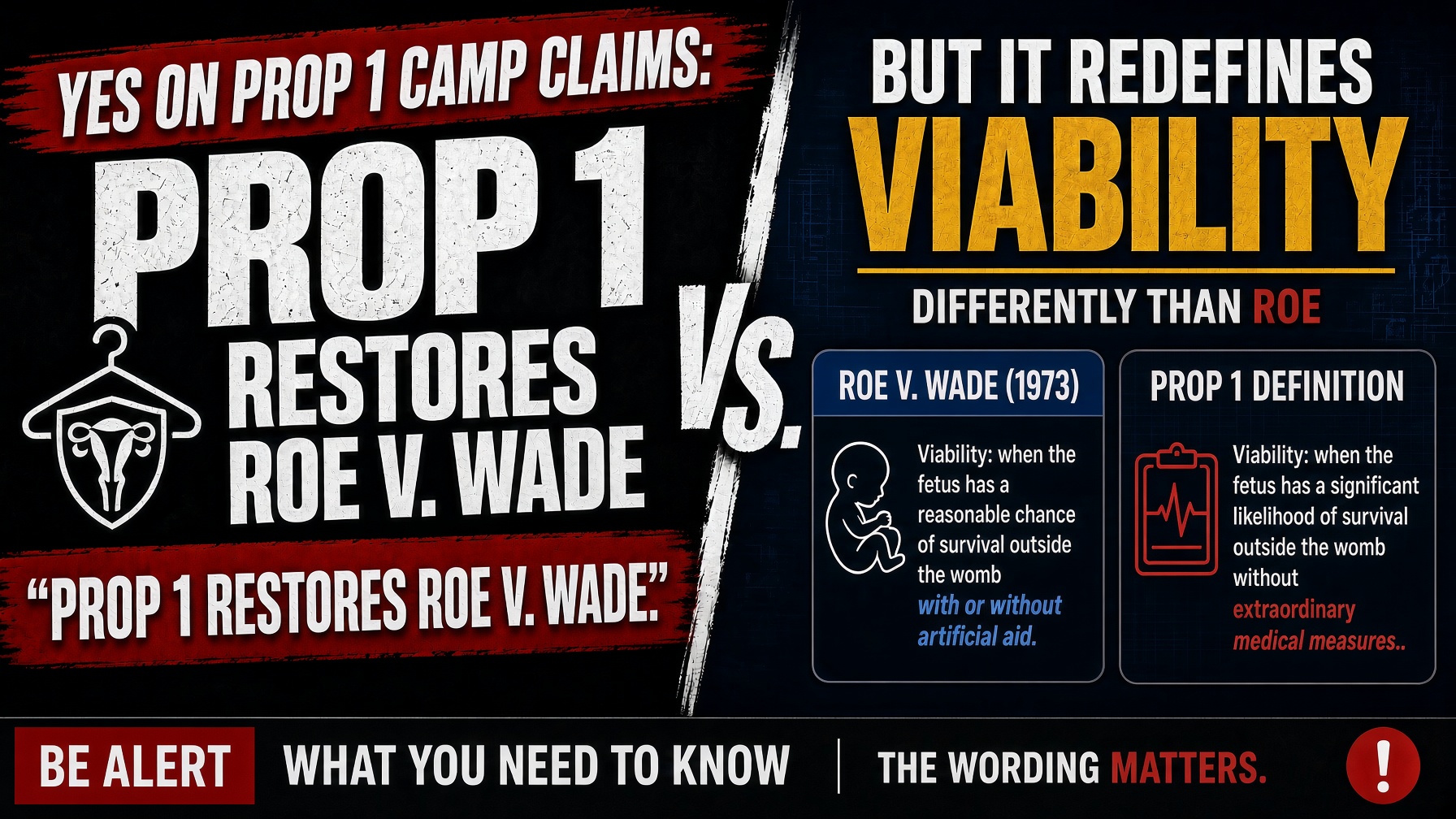
Yes on Prop 1 wants Idaho voters to believe Proposition 1 simply restores the old Roe v. Wade rules. The sales pitch is familiar: go back to the “pre-ban standard,” go back to nearly 50 years of practice, go back to Roe. United for Yes, the Yes campaign, says the initiative will “restore Idaho to the pre-ban standard,” including abortion “up to fetal viability.” See their own FAQ: unitedforyes.com/faqs.
Read the actual text. Prop 1 does not copy Roe’s definition of viability. It flips it.
That is the deception Stop Prop 1 is documenting in a new briefing from Too Extreme for Idaho PAC: How Prop 1 Re-Defines “Fetal Viability”. The claim on the billboards is restoration. The statute is redefinition.
Roe’s viability vs. Prop 1’s viability
In Roe v. Wade (1973), the Supreme Court described fetal viability as the point when the child is “potentially able to live outside the mother’s womb, albeit with artificial aid.” Artificial aid means oxygen, ventilators, NICU care: the ordinary tools that save premature babies every day in Idaho hospitals.
Prop 1’s definition, written into the initiative itself, is different. “Fetal viability” means the fetus “has a significant likelihood of sustained survival outside of the uterus without extraordinary medical measures.” That language is not a paraphrase of Roe. It is an inversion. Full text: unitedforyes.com/prop-1-full-text.
Stop Prop 1’s analysis puts the shift in plain English. Under Roe, a premature baby who would live with NICU support counted as viable. Under Prop 1, that same baby can be treated as not viable, because survival depends on what the measure calls “extraordinary medical measures.” Opponents say those two word flips move the line from roughly 22 to 24 weeks into the seventh or eighth month of pregnancy, opening the door to abortion on demand far later than Idahoans are being told.
“If they simply wanted to return abortion policy to what existed under Roe v Wade, they could have used the same definition for viability, but they did not,” said Dr. Megan Linders for Too Extreme for Idaho. “Words matter, and they used deceptive flips of familiar terms in an effort to trick voters into voting to legalize abortion on demand later than has ever been allowed in Idaho.”
Sell “restore.” Write “redefine.”
Campaign messaging leans hard on nostalgia for the Roe era. The ballot measure leans hard on a new legal dictionary. Idaho voters are not being asked to rubber-stamp 1973. They are being asked to enact a 2026 statute that moves the goalposts on when a baby counts as a life the state may protect.
After that redefined “viability,” Prop 1 still allows abortion in a broad “medical emergency,” including conditions that place a patient’s health in “serious jeopardy” or cause serious impairment or dysfunction of a bodily function or organ. That is another expansion layered on top of the viability rewrite. The Yes side markets exceptions and restoration. The text markets a new constitutional-style right that overrides other Idaho Code when they conflict.
Idaho is a pro-life state. Families here expect straight talk, not word games. If Yes on Prop 1 meant Roe, it could have written Roe. It wrote something else, then wrapped it in a “restore” slogan. That is not honesty. That is packaging.
Voters should read the Stop Prop 1 briefing, read the Yes campaign’s own restore language, and read the initiative definitions side by side. The contrast is the story. Prop 1 does not restore Roe’s viability standard. It redefines it, and then asks Idaho to call the rewrite a homecoming.
Sources: StopProp1.org; United for Yes FAQs; Prop 1 full text.